
Digital Resources From DRiBOND® Concrete Overlay Solutions LLC
DRiBOND's® most frequently asked questions HAZARDOUS MATERIAL NOTICE
DRiBOND® is a cementitious product containing silica and Portland cement. Appropriate protective measures should be undertaken when handling the product. OSHA safety guidelines, including OSHA FS 3681, should be followed when working with DRiBOND®.
Please reference the DRiBOND® website Material Safety Data Sheet, Education Center, and Technical Data Sheet for additional information.
Can DRiBOND® be used as a jointing sand?
DRiBOND® is not a jointing sand. It is an advanced dry polymer-modified bonding agent that was developed to efficiently and permanently bond hardscape paving materials to horizontal concrete surfaces.
Do not use DRiBOND® for the jointing of pavers as it could cause irreparable damage.
What preparation is needed prior to using DRiBOND®?
DRiBOND® comes as a ‘’ready-to-use’’ polymer-modified bonding agent that installs like sand and sets like cement, meaning no elaborate preparation is needed. The stable concrete substrate must be clean and dry before DRiBOND® application.
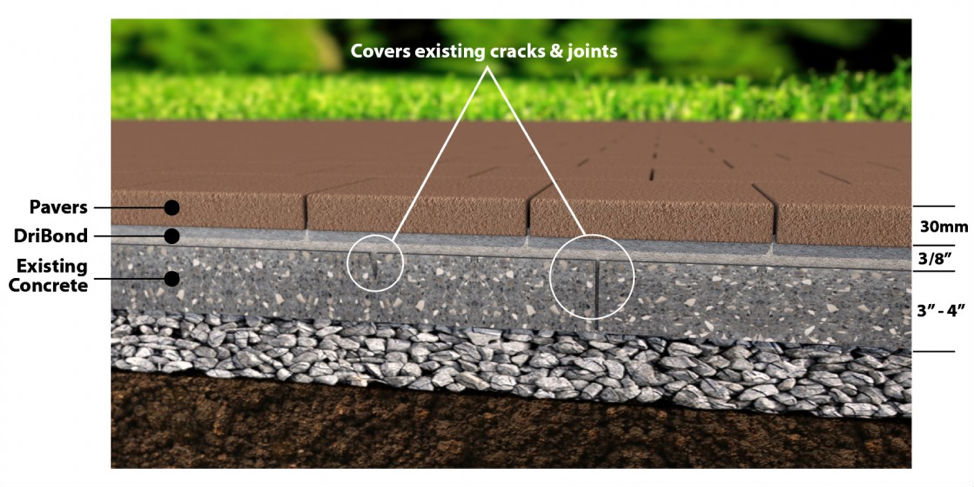
DRiBOND® will satisfactorily fill and repair concrete stress cracks. Any faults in the concrete surface beyond stress cracks should be addressed before bonding hardscape to the concrete. A solid and stable concrete surface is required before using DRiBOND® to overlay hardscape.
Please reference the DRiBOND® website Material Safety Data Sheet, Education Center, and Technical Data Sheet for additional information.
Is DRiBOND® durable?
A DRiBOND® concrete overlay is durable. DRiBOND® fully cures to 6,850 psi strength.
Is DRiBOND® capable of sustaining vehicular traffic?
Provided the concrete substrate is suitable for vehicular traffic, a DRiBOND® hardscape overlay will sustain vehicular traffic. DRiBOND® fully cures to 6,850 psi design strength in 28 days when applied correctly and the overlaid hardscape material typically has an 8,000+ psi rating (as compared with a typical concrete driveway at 4,000 psi strength).
Porcelain pavers used for vehicular applications should have a thickness of 2 cm+. No voids should be present under the hardscape being applied.
Please reference the DRiBOND® website Education Center, Technical Data Sheet and Material Safety Data Sheet for additional information.
What is DRiBOND®'s shelf life?
DRiBOND® has a shelf life of up to 18 months, dependent on humidity within the storage area. DRiBOND® is water activated and must be protected against moisture until it is applied over concrete.
Can DRiBOND® be used with hardscape materials other than pavers?
DRiBOND® can be used with a wide range of hardscape products, including porcelain pavers, brick and clay pavers, and natural stone products such as marble, granite, travertine, shell stone, and any other permeable stone product.
DRiBOND® is a nonpermeable product, and caution should be used when installing permeable hardscape materials (such as travertine) over DRiBOND® in areas subject to freeze-thaw conditions.
Please reference the DRiBOND® website Education Center, Technical Data Sheet and Material Safety Data Sheet for additional information.
Can DRiBOND® be used over asphalt?
No. DRiBOND® is designed for use over horizontal concrete surfaces such as driveways, pool decks, patios, lanais, and walkways.
Can DRiBOND® be used with natural stone?
DRiBOND® is ideal for efficiently overlaying natural stone products on concrete.
Please reference the DRiBOND® website Education Center, Technical Data Sheet and Material Safety Data Sheet for additional information.
Can DRiBOND® be used with porcelain pavers?
DRiBOND® has been successfully used for many years in a wide variety of porcelain paver installations.
Porcelain pavers used for vehicular applications should have a thickness of 2 cm+. No voids should be present under the hardscape being applied. Due to the rigidity of porcelain pavers, we recommend that vehicular traffic porcelain paver sizes not exceed 15” x 15”.
Please reference the DRiBOND® website Education Center, Technical Data Sheet and Material Safety Data Sheet for additional information.
Does DRiBOND® cause staining by bleeding through hardscape products or contribute to efflorescence?
DRiBOND® is a permanent bonding agent that does not cause staining by bleeding through hardscape products. DRiBOND® does not cause or contribute to efflorescence.
DRiBOND® comes as a ‘’ready-to-use’’ polymer-modified bonding agent that installs like sand and sets like cement. DRiBOND® should not be mixed with other materials. The substitution, alteration, or addition of any foreign matter or material to DRiBOND® will void all warranty considerations and could lead to bleeding and/or efflorescence.
Can DRiBOND® be used over exposed aggregate or stamped concrete?
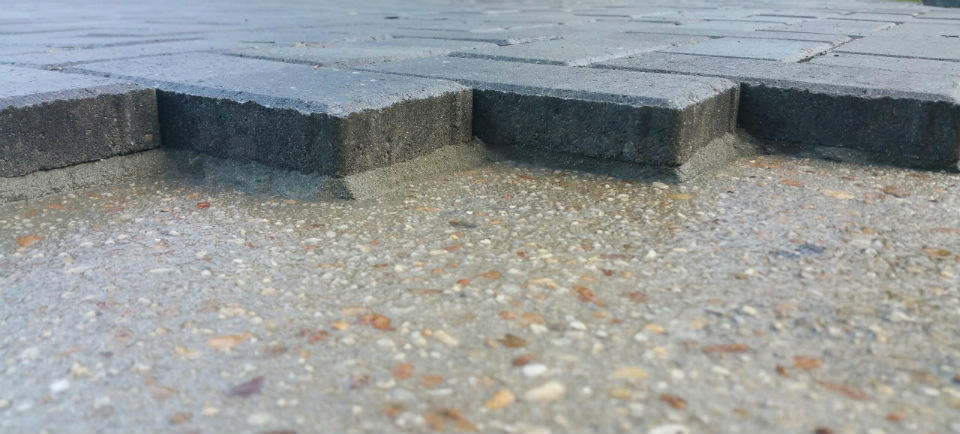
DRiBOND® can be used over both exposed aggregate concrete (such as Chattahoochee concrete) and stamped concrete. Due to the uneven nature of these surfaces, a larger product quantity may be required.
Please reference the DRiBOND® website Education Center, Technical Data Sheet and Material Safety Data Sheet for additional information.
What is DRiBOND® & how does it work?
DRiBOND® was created approximately 10 years ago and is an internationally patented polymer-modified bonding agent specifically developed to facilitate hardscape product overlays on stable concrete surfaces.
Millions of square feet of hardscape materials have been installed over driveways, pool decks, patios, lanais, and walkways using the patented DRiBOND® dry set technology.
DRiBOND® is an excellent substitute for wet mortar bed overlay applications on existing concrete. DRiBOND®’s polymer-modified, sand and Portland cement blend incorporates superior strength, dry set technology and is ready-to-use and easy to install. It saves time and effort as compared to traditional wet bed systems.
DRiBOND® acts as a permanent bonding agent allowing you to overlay and beautify your concrete with hardscape materials including porcelain pavers, concrete and clay pavers, and natural stone products such as marble, granite, travertine, shell stone, and any other permeable stone product.
DRiBOND® installs like sand and, upon water activation, sets like cement allowing hardscape installations to occur in a fraction of the time it would take to traditionally mud-set each hardscape piece.
DRiBOND® should not be mixed with other materials. The substitution, alteration, or addition of any foreign matter or material to DRiBOND® will void all warranty considerations and could lead to bleeding and/or efflorescence.
Please reference these DRiBOND® website materials for detailed installation instructions and additional information: Education Materials, Technical Data Sheet, and Material Safety Data Sheet.
Can DRiBOND® be used over existing sand-set pavers?
No. DRiBOND® is designed for overlay installations on existing dry stable concrete surfaces. It should not be used on a flexible base, such as asphalt, sand, dirt or any type of loose aggregate.
Can DRiBOND® be used in colder weather, in regions where the soil freezes?
DRiBOND® can be used in colder weather regions as it exceeds ASTM C666 requirements for freeze-thaw cycles with a 94% freeze-thaw ratio.
DRiBOND® installations should only be completed when the minimum daily temperature is at least 35 degrees Fahrenheit for at least 7 days following installation.
DRiBOND® is a nonpermeable product, and caution should be used when installing permeable hardscape materials (such as travertine) over DRiBOND® in areas subject to freeze-thaw conditions.
In colder weather regions, ALWAYS RESPECT FULL DEPTH EXPANSION JOINTS TO ALLOW FOR MOVEMENT OF INDEPENDENT CONCRETE DECKS! No hardscape materials should be overlaid over full-depth expansion joints without saw cutting the overlaid material directly over each expansion joint at a .250, 1/4” width or wider. Alternatively, each expansion joint can be bordered in a manner wherein the expansion joint is not covered with the overlaid hardscape material.
For hardscape materials laid over a full-depth expansion joint in freeze/thaw zones, it is recommended that the hardscape be cut with a wet-cut floor saw following the length of the joint at a .250, 1/4” width or wider. This allows independent decks to rise and fall independently as freeze/thaw cycles take place.
Please reference the DRiBOND® website Education Center, Technical Data Sheet and Material Safety Data Sheet for additional information.
How long after it rains should you wait to spread DRiBOND® on concrete?
DRiBOND® should only be spread on a completely dry concrete surface as the bonding agent is activated by contact with water.
Is humidity something that should be considered when using DRiBOND®?
Humidity is not a concern when applying DRiBOND®; however, the potential for rain should be considered.
DRiBOND® is a water activated bonding agent and, as such, should not be used when it is raining (sprinkler systems near the overlayed concrete area should also be deactivated). When the potential for rain exists, installers should use caution to not screed DRiBOND® too far outside of an area that can be timely overlayed with hardscape materials.
Can DRiBOND® be spread out in windy weather conditions?
Mild to moderate winds should not disrupt the use of DRiBOND®. DRiBOND® should not be used in excessively windy conditions.
Please reference the DRiBOND® website Material Safety Data Sheet, Education Center, and Technical Data Sheet for additional information.
How long should you wait between spreading DRiBOND® and laying down pavers?
Once DRiBOND® has been properly spread (screeded) over concrete, it is ok to immediately begin overlaying it with hardscape materials.
What should be used to best level out DRiBOND® across a concrete surface?
Use of the DRiBOND® ST300 Roller Screed Tool provides DRiBOND® screeding at the appropriate depth to minimize waste and ensure a cost effective, efficient application.
The ST300 Roller Screed Tool is available for purchase through the DRiBOND® website.
What is the recommended depth of DRiBOND®?
A minimum depth of 1/4 inch is required, and a depth of 3/8 inch is recommended for most DRiBOND® applications. DRiBOND® can be screeded to a depth of 1” to address certain situations.
Please reference the DRiBOND® website Education Center, Technical Data Sheet and Material Safety Data Sheet for additional information.
What is the coverage rate of DRiBOND®?
Screeded at the recommended depth of 3/8 inch, a 50-pound DRiBOND® bag covers approximately 30 square feet.
Please reference the DRiBOND® website Education Center, Technical Data Sheet and Material Safety Data Sheet for additional information.
Does a concrete surface need to be washed before DRiBOND®?
Concrete surfaces should be thoroughly cleaned prior to applying DRiBOND®. Use professional stain removing products as needed. The concrete surface should be pressure-washed and allowed to thoroughly dry before DRiBOND® application.
Please reference the DRiBOND® website Education Center, Technical Data Sheet and Material Safety Data Sheet for additional information.
When using DRiBOND®, how should height and elevation point differences be addressed? (ex. garage, curbs and preexisting sidewalks)
Please reference the DRiBOND® website Education Center and Technical Data Sheet for guidance on addressing height and elevation differences for garage, curbs, preexisting sidewalks, etc.
When overlaying hardscape on concrete, the creation of a transition area may be necessary to avoid a tripping hazard. Dependent upon the amount of slope and the elevation gap, it may be possible to cut and/or chisel the existing concrete to adapt the surface slope and avoid trip hazards.
Is it necessary to repair cracks in old concrete before using DRiBOND®?
DRiBOND® will satisfactorily fill and repair stress cracks; however, any crack or separation 3/4” wide or larger should be filled with a 6,000-psi fast set concrete prior to applying DRiBOND®.
Large cracks and damaged sections must be cut to full depth and repaired with concrete.
Please reference the DRiBOND® website Education Center and Technical Data Sheet for further guidance on this matter.
How does the DRiBOND® System 10-Year Limited Warranty Work?
Please reference the Warranty section of the DRiBOND® website for 10-Year Limited Warranty information.
Are there temperature or other weather considered when using DRiBOND®?
DRiBOND® is a water activated bonding agent and, as such, should not be used when it is raining (sprinkler systems near the overlayed concrete area should also be deactivated). When the potential for rain exists, installers should use caution to not screed DRiBOND® too far outside of an area that can be timely overlayed with hardscape materials.
DRiBOND® installations should only be completed when the minimum daily temperature is at least 38 degrees Fahrenheit for at least 7 days following installation.
DRiBOND® should not be used on excessively windy days.
Please reference the DRiBOND® website Education Center, Technical Data Sheet and Material Safety Data Sheet for additional information.
Is it ok to leave uncovered screeded (spread) DRiBOND® on a concrete surface overnight?
DRiBOND® screeded onto a concrete surface and covered with hardscape materials should be activated with water prior to the installer team leaving the job site each day. Any DRiBOND® not covered with hardscape should be removed and saved for future use prior to departing the job site.

WEBSITE PRIVACY POLICY
